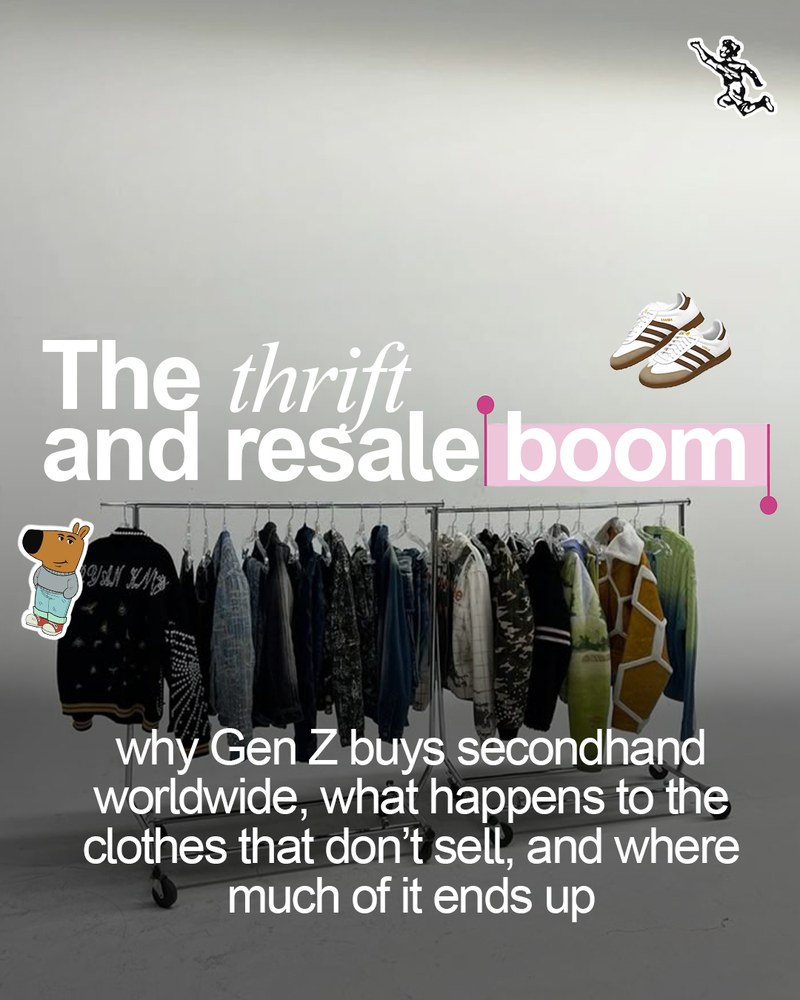
Scroll any feed and the pitch is the same: a vintage jacket, a ten-dollar find, a haul that feels like a small act of rebellion against fast fashion. Buying secondhand has become the sensible, even stylish, choice for a generation that grew up being told to care where things come from.
The numbers say it isn’t a niche anymore. ThredUp’s 2026 Resale Report, built on data from GlobalData, puts the global secondhand apparel market at about $393 billion, roughly 10% of all apparel spending (ThredUp, 2 April 2026). In the US, secondhand grew nearly four times faster than regular clothing retail in 2025. And the report projects that Gen Z and millennials will account for 71% of all market growth through 2030.
How do they find it? Nearly half of shoppers now discover secondhand pieces through social media, creators and influencer feeds, not through a search bar.
That is a genuine shift, and it’s mostly good news. Reusing a garment beats making a new one.
But a boom in buying is not the same as a boom in keeping. Every thrift store, resale app and donation bin has the same quiet problem: more clothes come in than can ever be sold. What happens to the rest is a story that runs through a market many Nairobians know by name.
Gikomba
Kenya has been buying the world’s used clothes for decades. We call them mitumba. In 2023, the country imported 198,000 tons of secondhand clothing worth about US$186 million, according to the Environment for Development Initiative (EfD), double what it was in 2013.
For a lot of people, this is work. The Mitumba Association of Kenya has said that over two million people are directly employed by the trade. It is also how many households afford to dress at all: Nation reporting noted that less than 3% of private consumption in Kenya goes to clothing and footwear, about Sh4,150 per person a year (Nation Newsplex).
And the trade has gone digital in a way the thrift boom abroad would recognise. Nation’s Newsplex found around 43 Kenyan mitumba Facebook groups with over 1,000 members each, adding up to over 1.1 million subscribers as of 2021. One of them, Mitumba Chap Chap, had passed 364,000. Joan Akinyi, then a 23-year-old engineering student, ran an Instagram page of over 6,000 followers and earned between Sh5,000 and Sh8,000 a week. “Instagram has worked well for me,” she told the paper, “because most of my customers use it.”
So mitumba is where the sharing economy and the survival economy meet. Neither is simple.
The part that doesn’t sell
Here is where the numbers start to disagree.
An EfD researcher, Richard Mulwa, estimates that between 20% and 50% of imported secondhand clothing in Kenya is unsellable and ends up as waste (EfD, 2025). The Mitumba Association disputes that, saying only about 2% becomes waste. Nobody has settled it, and we’d rather tell you that plainly than pick the number we like.
What is not disputed is that textile waste is showing up where people live. EfD reports that the Nairobi River and the Dandora dumpsite, especially near Gikomba, carry a heavy load of it. A survey of local traders cited clogged drainage, fire hazards, pests and stress. Dandora takes around 4,000 tonnes of waste a day, though the report doesn’t say how much of that is textiles.
Reporting from The East African noted that the Netherlands itself describes most of its used clothes exported to Kenya as “of very low quality”, and treats Kenya as a “disposal destination”.
So what do we do with the haul
None of this means you should stop thrifting. It means being honest about the chain:
- Buy to keep. The most sustainable garment is the one that doesn’t come back off your rail six months later.
- Don’t treat donating as disappearing. A bag at a donation bin is not a guarantee of a second life.
- Back the people in the middle. The traders in Gikomba aren’t the villains. They inherit what the world sends and make a living from it.
- Ask for better at the source. Mulwa has suggested import duties to limit volume. That is a policy debate worth having, with traders at the table.
The thrift boom is real, and so is the weight of what’s left over. The next time a haul video promises that nothing was wasted, ask where the rest went. In Nairobi, we may already know.
Sources
- ThredUp, 14th annual Resale Report (2 April 2026, GlobalData)
- EfD Initiative, Kenya’s second-hand clothes pose major waste crisis (2025)
- The East African / Business Daily, Why Kenya is second-hand clothes dumping ground (16 Feb 2024)
- Nation Newsplex, How social media has changed mitumba sales (c. mid-2021)